The way Narayan interlaces the two different streams of stories in the book is wonderful. The novel is a masterpiece in the way it is written and takes the reader to a visual tour of malgudi lansscape. The way Narayan has developd the city of malgudi is really exemplery. The transformation of Raju from a high society man to a saint is well laid.
Certain themes recur in the novels of Narayan. But as they are not particularly topical or provocative, they are not likely to attract attention to themselves. Narayan has deliberately avoided politics and polemics of any kind. All the same, the themes he chooses his novels will seem to be of perennial interest especially to a sensitive mind interested in human beings. One of them is man’s susceptibility to self-deception due to entertaining illusions. It is the most recurrent and it provides excellent field for Narayan’s comedy.
- Tags: ending of the guide by rk narayan, r k narayan as a novelist pdf, summary of the guide by rk narayan pdf, swami and friends by rk narayan pdf free download, the antidote rk narayan summary, the guide by rk narayan critical analysis pdf, the guide rk narayan read online, the lost umbrella by rk narayan.
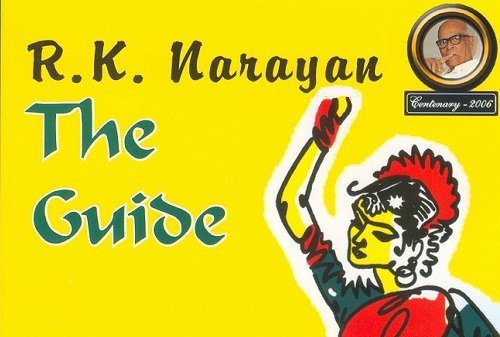
- About The Guide For the centennial of his birth, R. Narayan’s most celebrated novel Formerly India’s most corrupt tourist guide, Raju—just released from prison—seeks refuge in an abandoned temple. Mistaken for a holy man, he plays the part and succeeds so well that God himself intervenes to put Raju’s newfound sanctity to the test.
The other themes are: the study of the family and various family relationships, the renunciation, generational disaffiliation, conflict between tradition and modernity; the East-West encounter, education, etc. Narayan’s method is to treat his themes, not in abstract or didactic terms but in terms of individuals in flesh and blood and their experiences. And the universal appeal of his novels, although they confine themselves a narrow region in South India. The themes of Narayan are all inter-related and inter-dependent. But for purposes of study and analysis one may have to isolate them.
ADVERTISEMENTS:
The average and the middle-class milieu of Malgudi and the family provide Narayan to study at close quarters human individuals and human relationships in all variety and intricacy:
The mainspring of Narayan’s fictional art is his abiding, humane and responsible interest in varieties of people, especially the vast majority of the average and the ordinary, and in the limitless possibilities of their lives. In fact Malgudi which is wholly imaginary suburban town and the locale of the bulk of his fiction is a richly peopled world.
Here indeed one finds “God’s plenty.” Along with Malgudi the family provides the novelist with a convenient and manageable context, concrete and particular, to study at close quarter’s human individuals and human relationships in all variety and intricacy. It also helps him in creating the illusion of realism, so very necessary for the success of his kind of fiction in which the fabulous figures frequently.
The fictional world of R.K. Narayan in is largely devoted to the study of the family and various family relationships in detail:
ADVERTISEMENTS:
The fictional world of R.K. Narayan in its exploration of the familial relationship of the domestic world is largely devoted to the study of the family and various family relationships in detail, as the family forms the basic unit for any society. Narayan presents his protagonists against the background of their families and familial relations. He skillfully draws particular attention to the various details of their families. Many of them are seen as rooted in the traditions, customs, beliefs, and superstitions of their families. Thus every one of the important characters is given a recognizable identity and helped to come alive.
Rk Narayan Books
The first two novels of Narayan, Swami and Friends and The Bachelor of Arts illustrate this point. The central theme of either novel is growth towards emotional maturity which involves a crisis involving relations with others and the growth is made possible largely by the stability, solidarity and security of their respective families. The family is a secondary but significant theme in both the novels.
The Dark Room and The English Teacher appear chronologically after the first two novels and present the obverse and reverse of the theme of married life, the second of the traditional stages or garhasthya, according to the Hindu way of life. While The English Teacher presents the song of love in marriage, The Dark Room offers “a study of domestic harmony.” These two are pre-eminently domestic novels, and sensitive studies of husband-wife relationship, and they give ample scope for comparison and contrast.
Some of the novels examine the father-son relationship and grandmother-grandson and grandaunt-grandnephew relationships:
ADVERTISEMENTS:
The Financial Expert and The Vendor of Sweets explore the father-son relationship and the generation gap. While Margayya sheds his love of money and returns to the family fold, Jagan seeks release from the family bonds by taking to the stage of vanaprasthya, the third of the traditional stages. Waiting for the Mahatma and Painter of Signs novels delineate the grandmother-grandson and the grandaunt-grandnephew relationship peculiar to Indian culture and family.
Some of the novels deal with characters who become estranged from the conventions, codes and mores of the family who go out of the family fold:
Rk Narayan Novel The Guide
Certain individuals deliberately choose to isolate themselves from any and every form of family relationship and defy the norms and conditions of society, to seek their individual potential, only to render their services to the said society in one way or other, though they are termed “misfits.” The Guide, The Man-Eater of Malgudi, and The Painter of Signs present such characters who become estranged from the conventions, codes and mores of the family and society, who go out of the family fold either by necessity or by choice to live their lives independent of every one of the bonds. It is, as it were for them, the demand of the family and by the same token, society proves an obstacle to the development of their selves and to full realization of their potentialities.
Some of the novels deal with characters who strive to realize their absurd aims and ambitions, irrespective of the consequences:
There are others who in spite of the obstacles, obligations and limitations placed over them by the bonds of family and restricted by a strict social code, strive to realize their absurd aims and ambitions, irrespective of the consequences. However, it is brought home to them that society does not tolerate any such folly and finally they return to the folds of the society.
For, despite their absurd follies and foibles most of the characters remain conformists and tradition-bound, if not at the first at least towards the end, like Chandran, Savitri, Margayya and a multitude of other characters, who appear absurd and pathetic in their struggle with the tradition-bound society.
They are of course ultimately led to a stage where their illusions crumble and normalcy is restored. Thus they mature and are all the more wiser for their follies. For, to preserve the harmony between all individuals and society, individual ambitions have to be subdued.
Some of the novels deal with the theme of renunciation:
The protagonists of some of the novels feel impelled to try some form of renunciation because of frustration, disappointment, failure, irreparable loss, and failure of relationship. Here Narayan tells us of the fraudulent holy man or guru, ideal sainthood and about the real ascetic or sanyasi. To start with, The Bachelor of Arts and The Dark Room grouped together to facilitate the purpose of study; explore the premature and ignorant renunciation taken up to escape certain emotional crises and subsequent upheaval in their lives.
The English Teacher which comes chronologically after the other two novels depicts Krishna’s grief at the premature death of his wife, and his coming to terms with the tragic fact. His coming into psychic contact with the spirit of his wife enables him gradually to accept her death as well as develop equanimity of mind and inner calm, considerable degree of non-attachment, and serenity of mind associated with the sthithaprajna. In Waiting for the Mahatma Narayan takes the risk of introducing Mahatma Gandhi as a character.

The Mahatma belongs to the class of the extraordinary while the ordinary and average are Narayan’s forte. The Mahatma’s humanity and compassion are stressed, he is seen as the living embodiment of the very essence of renunciation—ideal sainthood. Living in the midst of people whose joys and sorrows he shares, he also cultivates at the same time an inner calm. The Guide presents the theme of the fraudulent holy man or guru from a fresh angle.

The novelist makes a satiric exposure of the false sanyasi far less important than focusing attention on the role of faith that a credulous community places in one who is believed to be a holy man, and its consequences to both the ascetic as an individual and as a public figure, and to the humanity. The Vendor of Sweets tells the story of Jagan, an eccentric and an obscurantist father, who can be devoted to Gandhi and the Gita, and also make handsome profits as a sweet-vendor, his absurd affection for his son, and his disillusionment and withdrawal from familial attachment and entering of vanaprasthasrama.
A Tiger for Malgudi, written sixteen years after the Vendor of Sweets, is in many ways an unusual and challenging novel. This is because under the guise of telling the apparently fantastic and improbable story of a jungle tiger attaining true enlightenment, Narayan actually tells a story whose real theme is renunciation or sanyasa.
Narayan uses of various myths and legends from the classical Indian traditional Indian literature, epics and tales in his fiction by improving and improvising to suit the modern times:

Narayan renders into modern fiction various myths and legends drawn from the classical Indian traditional literature, epics and tales such as the Mahabharata, the Bhagavata, Jataka tales and the Panchatantra, the world famous and internationally known collection of animal stories. Taken from these various traditional sources the myths and legends are improved and improvised to suit the modern times and contemporary situation.
Through these stories Narayan tries to present a view of life and a moral vision in terms of the comic mode, though never didactic or instructive anywhere. In the words of George Woodcock: “The ancient Indian myths which Narayan began to read within his middle years are not merely plots for films; his novels recreate them.” Therefore one can that Narayan’s view of is essentially Indian and that his novels offer a recreation of the traditional imagination as it acts upon the individual consciousness with the contemporary society.
Narayan’s vision is characterized by a unique Indian sensibility:
Narayan is a writer with a full commitment to certain spiritual and religious ideas with which Indians are normally familiar and he has been able to penetrate into the core of Indian life without being hampered by problems of regionalism, religion, caste and class with which an Indian writer has to come to grips. What is characteristically great about him is that he has been able to capture the essence that is Indian.
That Narayan’s vision is characterized by a unique Indian sensibility is of no doubt. And his adherence to the ancient Indian tradition—(as reflected in his fictional world) a tradition which is deeply rooted in the beliefs of the transmigration of the soul, karma, reincarnation and renunciation, becomes clear through a perceptive study of his fiction.
The religious sense of Indian myth is part of Narayan’s grip of reality and his particular of view of human life and way of placing and ordering human experience:
Almost all his novels touch upon the above mentioned themes. The only difference being that while in some of the novels they form the major themes, in others they provide a significant and added meaning to the narration. As one of his characters in the novels comments, he always finds “some ancient model.” He always comes upon an ancient myth or legend which lends itself to him to express his moral vision of life. As William Walsh observes: “The religious sense of Indian myth is part of Narayan’s grip of reality and his particular view of human life and his individual way of placing and ordering human experience.”
The Guide is the most popular novel of R.K. Narayan. It was published in 1958, and won the Sahitya Akademy Award for 1960. It has also been filmed and the film has always drawn packed-houses.
It recounts the adventures of a railway guide, popularly known as ‘Railway Raju’. As a tourist guide he is widely popular. It is this profession which brings him in contact with Marco and his beautiful wife, Rosie. While the husband is busy with his archaeological studies, Raju seduces his wife and has a good time with her. Ultimately Marco comes to know of her affair with Raju and goes away to Madras leaving Rosie behind. Rosie comes and stays with Raju in his one-room house. His mother tolerates her for some time, but when things become unbearable, she calls her brother and goes away with him, leaving Raju to look after Rosie and the house.
Rosie is a born dancer, she practices regularly and soon Raju finds an opening for her. In her very first appearance, she is a grand success. Soon she is very much in demand and their earnings increase enormously. Raju lives lavishly, entertains a large number of friends with whom he drinks and gambles. All goes well till Raju forges Rosie’s signatures to obtain valuable jewellery lying with her husband. The act lands him in jail. Rosie leaves Malgudi and goes away to Madras, her hometown. She goes on with her dancing and does well without the help and management of Raju, of which he was so proud.
image source: blogimages.indianroots.comADVERTISEMENTS:

On release from jail, Raju takes shelter in a deserted temple on the banks of the river Sarayu, a few miles away from Malgudi, and close to the village called Mangla. The simple villagers take him to be a Mahatma, begin to worship him, and bring him a lot of eatables as presents. Raju is quite comfortable and performs the role of a saint to perfection.
However, soon there is a severe famine drought, and the villagers expect Raju to perform some miracle to bring them rain. So he has to undertake a fast. The fast attracts much attention and people come to have darshan of the Mahatma from far and wide. On the twelfth day of the fast, Raju falls down exhausted just as there are signs of rain on the distant horizon. It is not certain if he is actually dead or merely fainted. Thus the novel comers to an1 abrupt close on a note of ambiguity.
The last pages of Narayan’s best novel, The Guide, find Raju, the chief protagonist, at the end of a lifetime of insincerity and pain. As a professional guide to Malgudi’s environs, he invented whole new historical pasts for bored tourists; he seduced a married woman, drifted away from his old mother and friends, became a flashy cultural promoter, and then tried, absentmindedly, to steal and was caught and spent years in jail, abandoned by everyone.
ADVERTISEMENTS:
His last few months have been spent in relative comfort as a holy man on the banks of a river: a role imposed on him by reverential village folk. But the river dries up after a drought and his devotees start looking to him to intercede with the gods. Raju resentfully starts a fast, but furtively eats whatever little food he has saved. Then abruptly, out of a moment of self disgust, comes his resolution: for the first time in his life, he will do something with complete sincerity, and he will do it for others: if fasting can bring rain, he’ll fast.
He stops eating, and quickly diminishes. News of his efforts goes around; devotees and sightseers, gathering at the riverside, create a religious occasion out of the fast. On the early morning of the eleventh day of fasting, a small crowd watches him quietly as he attempts to pray standing on the river bed and then staggers and dies, mumbling the enigmatic last words of the novel, “It’s raining in the hills. I can feel it coming up under my feet, up my legs….”
Characteristically, Narayan doesn’t make it clear whether Raju’s penance does actually lead to rain. He also doesn’t make much of Raju’s decision, the moment of his redemption, which a lesser writer would have attempted to turn into a resonant ending, but which is quickly passed over here in a few lines. What we know, in a moment of great disturbing beauty, is something larger and more affecting than the working-out of an individual destiny in an inhospitable world.
It is and the words are of the forgotten English writer William Gerhardie, on Chekhov, but so appropriate for Narayan that sense of the temporary nature of our existence on this earth at all events…through which human beings, scenery, and even the very shallowness of things, are transfigured with a sense of disquieting importance.
ADVERTISEMENTS:
It is a sense of temporary possession in a temporary existence that, in the face of the unknown, we dare not overvalue. It is as if his people hastened to express their worthless individualities, since that is all they have, and were aghast that they should have so little in them to express: since the expression of it is all there.