- To start SQL Developer, go to the sqldeveloper directory under the sqldeveloperinstall directory, and do one of the following, as appropriate for your operating system: On Linux and Mac OS X systems, run sh sqldeveloper.sh. On Windows systems, double-click sqldeveloper.exe.
- Installing SQL Developer on Ubuntu 16.04.
- Installing Sql Developer On Parallels For Mac Pro
- Oracle Sql Developer For Mac
- Sql Developer Install Steps
Frequently Asked Questions
- 1. Customers who purchased and registered a copy of Parallels Desktop 15 for Mac from the Parallels Online Store or an authorized reseller on or after August 1, 2020 through September 30, 2020, are eligible for an upgrade to the next version of Parallels Desktop for Mac at no charge, subject to certain conditions. For details on the Tech Guarantee 2020, please visit the Tech Guarantee page.
Note: : If you have a subscription for Parallels Desktop for Mac, Parallels Desktop for Mac Pro Edition, or Parallels Desktop for Mac Business Edition, you can upgrade Parallels Desktop to the latest version with the license you own. Download and install Parallels Desktop 16 and use your subscription license for activation. - You should receive your upgrade key within 7 days after the new version of Parallels Desktop for Mac becomes available. The upgrade key will be sent to the email that was used for registration of your Parallels Desktop 15 for Mac license.
If you have not yet registered your copy of Parallels Desktop 15 for Mac, please register it in your Parallels account.
- Does Windows come pre-installed with Parallels Desktop for Mac?
Windows is not included with your purchase of Parallels Desktop for Mac. Windows can be purchased directly from Microsoft or retail stores. Please visit KB 9003 for additional information. - Will Parallels run on my current Mac hardware?
A full list of system and hardware requirements can be found here. - What is the difference between Standard and Pro Editions?
Visit KB 123296. - What is the difference between a permanent license and a subscription?
Visit KB 122929. - Can I use my license on multiple Mac computers?
Parallels licenses are valid only on one Mac per license. For more information, please reference www.parallels.com/about/eula/. - Do you have discounts for Students/Education Staff/offer academic licenses?
Yes. For more information on Education licenses, visit KB 113630. - Is there a trial version of Parallels Desktop for Mac I can evaluate before purchasing?
Yes, Parallels offers a free 14 day trial at www.parallels.com/products/desktop/trial/
- Install or upgrade to the latest version of Parallels Desktop for Mac.
Visit KB 124250. - Install Windows in Parallels Desktop for Mac.
Visit KB 4729. - Migrate my current Windows PC to a Parallels Desktop for Mac virtual machine.
For instructions, visit KB 123929. - Register and activate Parallels Desktop for Mac.
Visit KB 124225. - Launch Windows from Parallels Desktop for Mac.
Visit KB 115170. - Upgrade my license to Pro Edition
Visit KB 123159. - Install Quicken, MS Office or other software in Windows virtual machine.
Visit KB 119310. - Learn how to use the Coherence mode.
Visit KB 4670. - Learn how to use the Parallels Desktop sharing tools.
Visit KB 122567.
SQL Developer 4.1 is easy to set up and use, so there is very little setup required to follow the code examples for learning SQL and PL/SQL. The best way to learn is by practice, and for that you'll need a computer with access to an Oracle database and SQL Developer.
- What is Parallels Toolbox?
Visit KB 123903 and KB 124200 to learn about Parallels Toolbox for Mac and for Windows. - How can I get Parallels Toolbox?
See KB 123902 about Parallels Toolbox for Mac and KB 124202 about the Windows version. - How do I install Parallels Toolbox?
Visit KB 123904 for information on the Mac version, and KB 124183 to learn how to install the Windows one.
- How to give more hard disk space to a Windows virtual machine?
Visit KB 113972. - How can I improve virtual machine performance on my Mac?
Visit KB 112091 . - How to reinstall Parallels Tools in Windows Guest OS?
Visit KB 4841. - Fix network issues in a Windows virtual machine.
Visit KB 8978. - Free up disk space on Mac.
Visit KB 123553. - Fix 'There's not enough disk space available to start the Windows virtual machine.'
Visit KB 10117. - Fix 'Unable to connect USB device to virtual machine now. Try to connect this USB device later.'
Visit KB 10136.
In BTM 382 Database Management, we use Oracle, the world’s most popular enterprise DBMS. I strongly recommend that for this course you install Oracle on your own computer, for the following reaons:
- The project and one of the homework assignments will involve extensive use of Oracle. Without installing it on your own computer, it will be very difficult to succeed in these exercises and contribute effectively to your team project.
- For the sake of your learning, if you really want to know Oracle, the installation procedure is an important part of the learning experience.
- At the end of this class, you should all be able to add your knowledge of Oracle on your CVs. Beyond just knowing how to write Oracle SQL queries, it would be good to be able to specify that you also know how to install Oracle and set up databases.
That said, after explaining how to install Oracle, I provide a couple ways to run Oracle without actually installing it, each of which has some disadvantages.
Contents
- 1 How to install Oracle
- 2 How to run Oracle without installing it
How to install Oracle
There are two components to Oracle: the DBMS itself (called “Oracle Database”) and a graphical user interface called “SQL Developer”. (Note that the textbook uses a command-line interface that comes with the Oracle Database; I don’t recommend this.) Once you’ve installed Oracle Database and Oracle SQL Developer, you need to establish connections in SQL Developer to give yourself a suitable workspace. Here I present this installation and configuration in three steps.
1. Install Oracle Database (Windows and Linux only)
You can install Oracle Database 11g XE Express Edition (the free version of Oracle). You can download it either from the course website (64-bit Windows, 384 MB, BTM 382 password required) or directly from Oracle for other versions (registration required). Here are some important notes:
Installing Sql Developer On Parallels For Mac Pro
- During installation, you will be asked to enter a password. REMEMBER THIS PASSWORD! If you forget it, then you will have no choice but to completely uninstall and then reinstall Oracle. A low security password is perfectly fine if you are only using Oracle locally on your own computer.
- Current versions of Oracle Database do not run on Apple OS X (welcome to the business computing world). To run it on an Apple computer, you must run Windows on your computer either using Boot Camp (recommended) or a virtual machine like Virtualbox or Parallels. You can see complete instructions in one of the tutorials linked below.
- Most BTM 382 students should have access to a free version of Windows in MyConcordia | Software and Applications | DreamSpark Premium | Popular.
2. Install Oracle SQL Developer (Windows and Linux only)
Oracle Sql Developer For Mac
After installing Oracle Database, you can then install Oracle SQL Developer (also free). You can download it either from the course website (64-bit Windows, 373 MB, BTM 382 password required) or directly from Oracle for other versions (registration required). Here are some important notes:
- If you download SQL Developer yourself from Oracle, I recommend that you choose the version that includes the JDK. That avoids a lot of of potential problems with Java.
- Oracle SQL Developer is a Java application. It does not require installation; it only requires you to unzip the file and then find and run sqldeveloper64.exe. That’s it.
- Oracle SQL Developer does not work unless you have installed Oracle Database (see previous step), and it is running.
- Although there is an Apple OS X version of Oracle SQL Developer, it assumes that you are connecting to an Oracle Database on another computer (since Oracle Database doesn’t run on OS X). So, don’t choose the OS X version of SQL Developer; rather, choose the same operating system version for which you installed Oracle Database in the previous step.
3. Configure a dedicated user account for Oracle SQL Developer
Finally, after installing Oracle SQL Developer, you will probably want to create a dedicated user account with a dedicated connection as explained in the following video.
Other tutorials for installing Oracle Database and SQL Developer (including Mac)
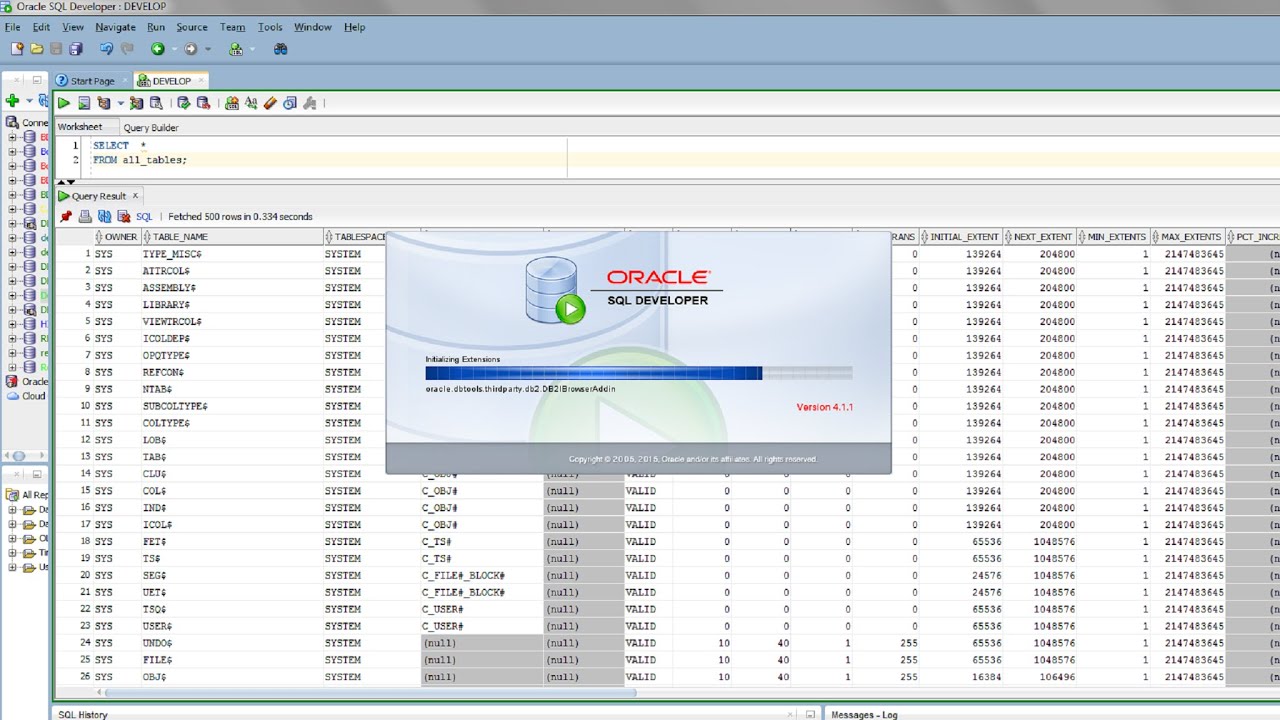
In addition to the instructions above, here are some tutorials for installing Oracle:
- Official Oracle installation instructions for Windows and for Linux
- Video tutorial for installing Oracle XE and SQL Developer on Windows: Not a great tutorial, but the best I’ve found
- Tutorial for installing Oracle on Apple OS X
How to run Oracle without installing it
There are at least two free “online” versions of Oracle that let you run Oracle without actually installing it. (Oracle also has a cloud version, but it ain’t cheap–I won’t cover it here.) Althouth easy to get started, neither of these options lets you save your work in a persistent database; they only let you play around with SQL scripts.
SQL Fiddle
SQL Fiddle is without a doubt the easiest way to run SQL queries. It works not only for Oracle, but for many other major DBMSs, and so it’s a great way to dabble with and compare different SQL versions without the hassle of having to install them or dealing with virtual machines and incompatible operating systems. so, be sure to select Oracle (specifically, “Oracle 11g R2”) as the database in the top left drop-down box as shown here:
However, SQL Fiddle only supports very small databases, and so would not work for the project for this class. However, it is great for learning and quick tests. A good video tutorial is available on YouTube (though the tutorial isn’t specific to Oracle).
Oracle Live SQL
Sql Developer Install Steps
In 2016, Oracle launched Oracle Live SQL, a free, online version of Oracle. To use it, you need to sign up for a (free) Oracle account. Jeff Smith (Oracle SQL Developer guru) has an introductory article to the service.