Follow the instructions below to download, install and connect the AnyConnect Secure Mobility Client on your Mac computer (OS X 10.9 or newer) to the new MSU VPN.
CISCO ANYCONNECT VPN INSTALLATION FOR MACINTOSH VERSION 4.8.0190 - MAC OS 10.15.x AND BELOW Open your Web Browser (Safari, Firefox, or Chrome) In the Address box, please type Enter your SJU email address and your password, in the username & password boxes. Cisco AnyConnect - Empower your employees to work from anywhere, on company laptops or personal mobile devices, at any time. AnyConnect simplifies secure endpoint access and provides the security necessary to help keep your organization safe and protected.
Instructions
Download:
- Go to https://www3.montana.edu/software.
Locate the Cisco AnyConnect (VPN Client) section (see image below). - Click box next to I accept Software Terms of Use.
- Click the AnyConnect Secure Mobility Client (4.8) download link in the Mac OS X row (shownin red below).
The installer file downloads. When download is complete, follow steps below to install.
Install client:
- Go to your Downloads folder (or whatever location the file was downloaded to) and double-click anyconnect-macos-4.8.00175-core-vpn-webdeploy-k9.dmg to unzip.
- Double-click anyconnect-macos-...pkg file to begin installation (see 1st image below).
The AnyConnect Secure Mobility Client Installer window opens (see 2nd image below). - Click Continue and follow the steps to install.
- Enter your computer's password when prompted.
- Click Close to shut installer window, after installation is finished.
- Click the Move to Trash button when prompted.
Installation will now be complete.
Connect to VPN:
- Go to your Applications folder, open the Cisco folder and then click the Cisco AnyConnect Secure Mobility Client. app.
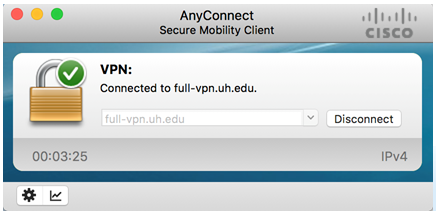
The AnyConnect window opens (see image below). - Enter vpn.msu.montana.edu (if not already entered) and click Connect (see top image below).
In the login window that opens (see bottom image): - Select Group (appropriate for you role at MSU, ie MSU-Employee or MSU-Student).
- Enter NetID and NetID password, click OK.
You will now be connected to the MSU VPN. The Cisco icon in the dock will now have a little padlock on it and a tiny version Cisco round logo with padlock will be displayed on top menu bar.
To disconnect:
Right-click on the icon in top menu bar and select Disconnect.
To connect in the future:
You will no longer go through Network Preferences to connect to the VPN, just use the AnyConnect app.
Connect by right-clicking on the Cisco AnyConnect icon in the top menu bar or dock, then click the Connect button in the 'VPN Ready to connect' box.
If you don't see the icon in your top menu bar or dock, go to your Applications folder, open the Cisco folder and click the AnyConnect Secure Mobility Client.app. Next click the Connect button as shown in the image under step 4 above.
Overview
Tufts AnyConnect provides valid Tufts users with secure remote access to the Tufts network. From a desktop or laptop computer, AnyConnect allows full access to all Tufts network resources, such as P:, Q:, and R: drives and restricted Web pages, and provides users with an experience very similar to the one they enjoy while on campus. The pages give more information about the AnyConnect Desktop Application.
1. Visit the Tufts Box folder that contains the AnyConnect executable files that are required for installation of the application.
2. Find the file that you require for your computer.
- If you are on an Apple computer, you will want the file that contains 'Mac' in the file name. (Note: The file name ends with .pkg and the file type is Disk Image.)
- If you are on a Windows computer, you will want the file that contains 'Windows' in the file name. (Note: The file name ends with .exe and the file type is Application.)
3. Click on the More Options button for that file.
Cisco Anyconnect For Mac Catalina
4. Click on Download.
5. Find the AnyConnect executable file that was downloaded to your computer.
6. Double-click on the file to open it and follow the steps in the installer to complete the installation. During this process you may be asked to enter your administrator credentials. If you are on a Tufts computer and do not have administrator rights, contact the Tufts Technology Service Desk at (617) 627-3376 for assistance.

Note for Mac Users
- If you are on a Mac, you may get a warning that the file comes from an 'unidentified developer'. Click OK.
- Open your System Preferences and select Security & Privacy.
- The bottom portion of the Security & Privacy window will have a message about the AnyConnect installation file being blocked. Click Open Anyway.
- A window will appear asking you to confirm that you want to open the file. Click Open.
1. Locate the AnyConnect Application on your computer.
On a PC go to Start > Programs. Locate and open the Cisco folder.
On a Mac go to the Applications folder and select the Cisco folder.
2. Double click on the Cisco AnyConnect Secure Mobility Client application to open it.
Anyconnect For Macintosh Vs
3. Enter vpn.tufts.edu/duo in the VPN server field. (Note: This field may autofill with 'vpn.tufts.edu'. If so, make sure to add '/duo' to the end.)
4. Click Connect. An authentication window will appear.
5. Enter your Tufts username (eg. jjumbo01) and password.
6. In the field next to Duo Passcode or Authentication method or Second Password, you have a few options:

- Enter Duo Passcode - Enter the six-digit passcode you are provided by the Duo mobile app on your smartphone.
- Type the word 'push' - Duo will send you a push notification via the Duo mobile app on your smartphone.
- Type the word 'phone' - Duo will call the phone number you have registered for verification.
7. Click OK.
8. Depending on which authentication method you chose, there may be some next steps:
- If you entered a six-digit Duo Passcode correctly, you should be connected to the VPN.
- If you entered 'push', you will receive a push notification on the Duo mobile app on your smartphone. Click Approve to complete the login process.
- If you entered 'phone', you will receive a phone call at the number you have registered with Duo. When prompted, press any key to verify your login.
9. Once your login has been verified, you will be able to use the VPN. Any AnyConnect icon will appear in your status bar on a PC or the menu bar on a Mac indicating that you now have a secure link to the Tufts network.
10. Remember to disconnect at the end of every session to ensure that you do not have a secure link open for another user to access.
One of the benefits of connecting to the VPN portal a secure remote access connection to the Tufts network with full access to all Tufts network resources, such as P:, Q:, and R: drives. Click this link to locate instructions on how to map to and access network drives on both a PC and a Mac.
A Note on Working Directly off of a Network Drive
It is possible, while using the AnyConnect application, to work on documents directly through a network drive, but it is not advised. Connection issues may corrupt open network documents. Additionally, if the document is on a shared drive, working directly on the network copy keeps others from being able to view or copy the file. To avoid any issues, best practice is to work off of a local copy (a file copied from a network drive to your local computer). While using the AnyConnect application, locate your document and save it to your local computer. Once you have completed your work, you can copy it back to the network drive.
1. Click on the AnyConnect icon on your status bar (PC) or menu bar (Mac).
2. Select Disconnect.